

Intel was the memory company. Grove and Moore killed it in 1985.
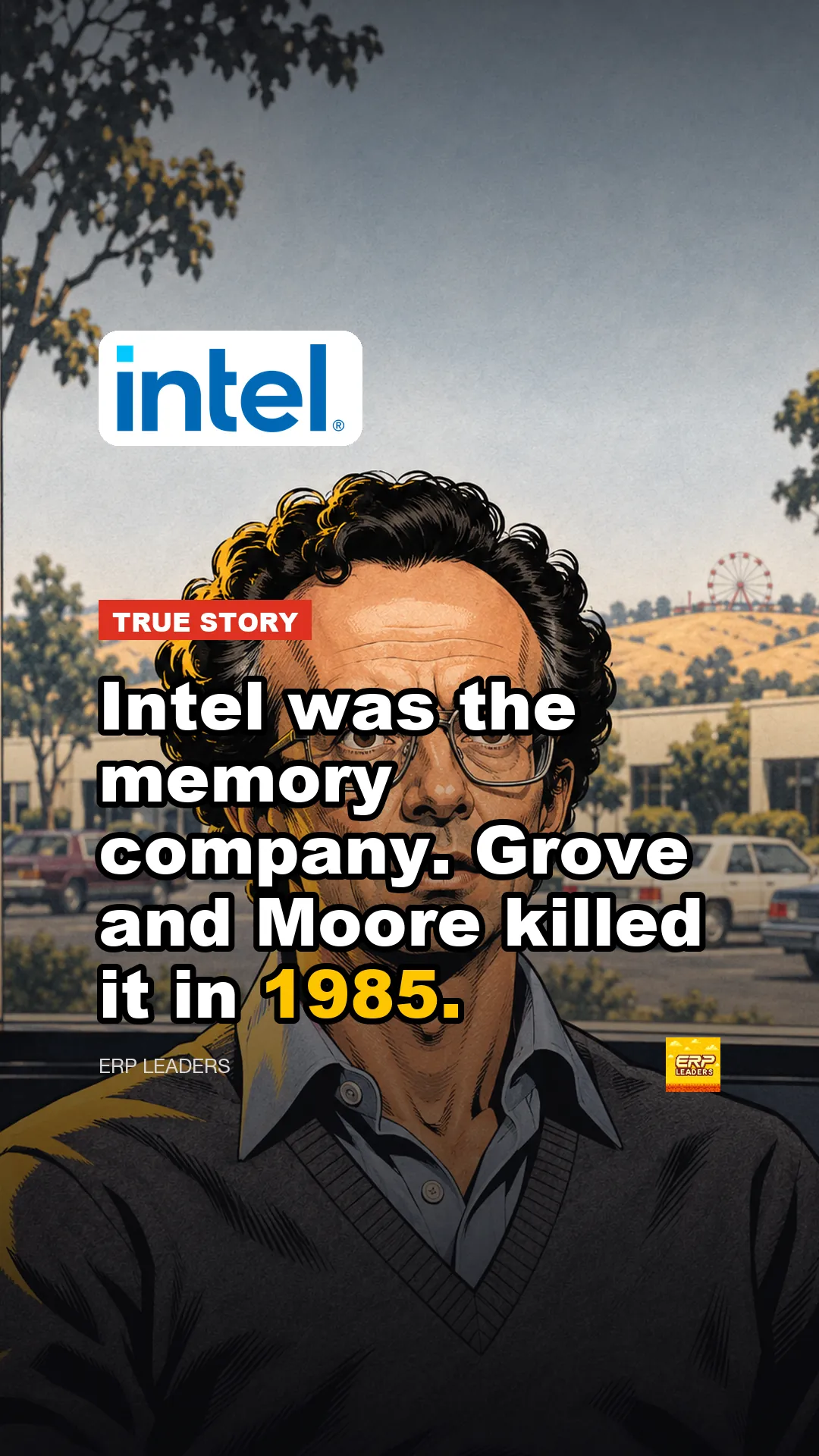
Intel sold memory chips, the parts that hold a computer's working data. Its cheap 1970 chip was the industry's first mega-hit. Then Japanese firms made memory cheaper and better. American rivals went under, and Intel's profit fell from $198 million in 1984 to under $2 million a year later.
Grove, Intel's president, and CEO Gordon Moore agonized for weeks. Grove recalled looking out at a distant Ferris wheel, then asking what a new boss would do. Moore answered without hesitation: "He would get us out of memories." Grove stared at him, numb, then said: "Why shouldn't you and I walk out the door, come back, and do it ourselves?"
They did. In 1985 Intel phased out DRAM, the memory chips it had pioneered, and bet on microprocessors. Over two years it cut 7,200 jobs through attrition and layoffs and closed eight older plants; in 1986 it lost over $180 million, its only loss since the startup days. In 1992 its profit topped $1 billion for the first time.
Their question took their own history out of the decision: what would new management do?
AI-generated illustration with narration by an AI voice.
Which system would you stop investing in?
What the captions say
- This is the story of how Andy Grove imagined being replaced in 1985, then took Intel out of DRAM memory chips with Gordon Moore.
- At the time, Intel was the memory company. In 1970, its cheap memory chip had been the industry's first mega-hit.
- Grove was Intel's president. His boss, the CEO, was Gordon Moore. Japanese firms were already making memory chips cheaper and better.
- Many American memory chip companies went under. Intel's profit fell from $198 million in 1984 to under $2 million a year later.
- For weeks, Grove and Moore agonized. Grove recalled looking out the window at a Ferris wheel in the distance.
- Then Grove turned back and asked Moore: "If we got kicked out and the board brought in a new CEO, what do you think he would do?"
- Moore answered without hesitation: "He would get us out of memories."
- Grove stared at him, numb. Then he said: "Why shouldn't you and I walk out the door, come back, and do it ourselves?"
- So they did. In 1985 Intel phased out its DRAM memory chips and bet on microprocessors, refusing to license its new 386.
- It hurt. Over two years Intel cut 7,200 jobs and closed eight older plants. In 1986 it lost over $180 million.
- Six years later, in 1992, Intel's profit topped $1 billion for the first time.
- After weeks of agonizing, it came down to one question, asked by a window, as a Ferris wheel turned.