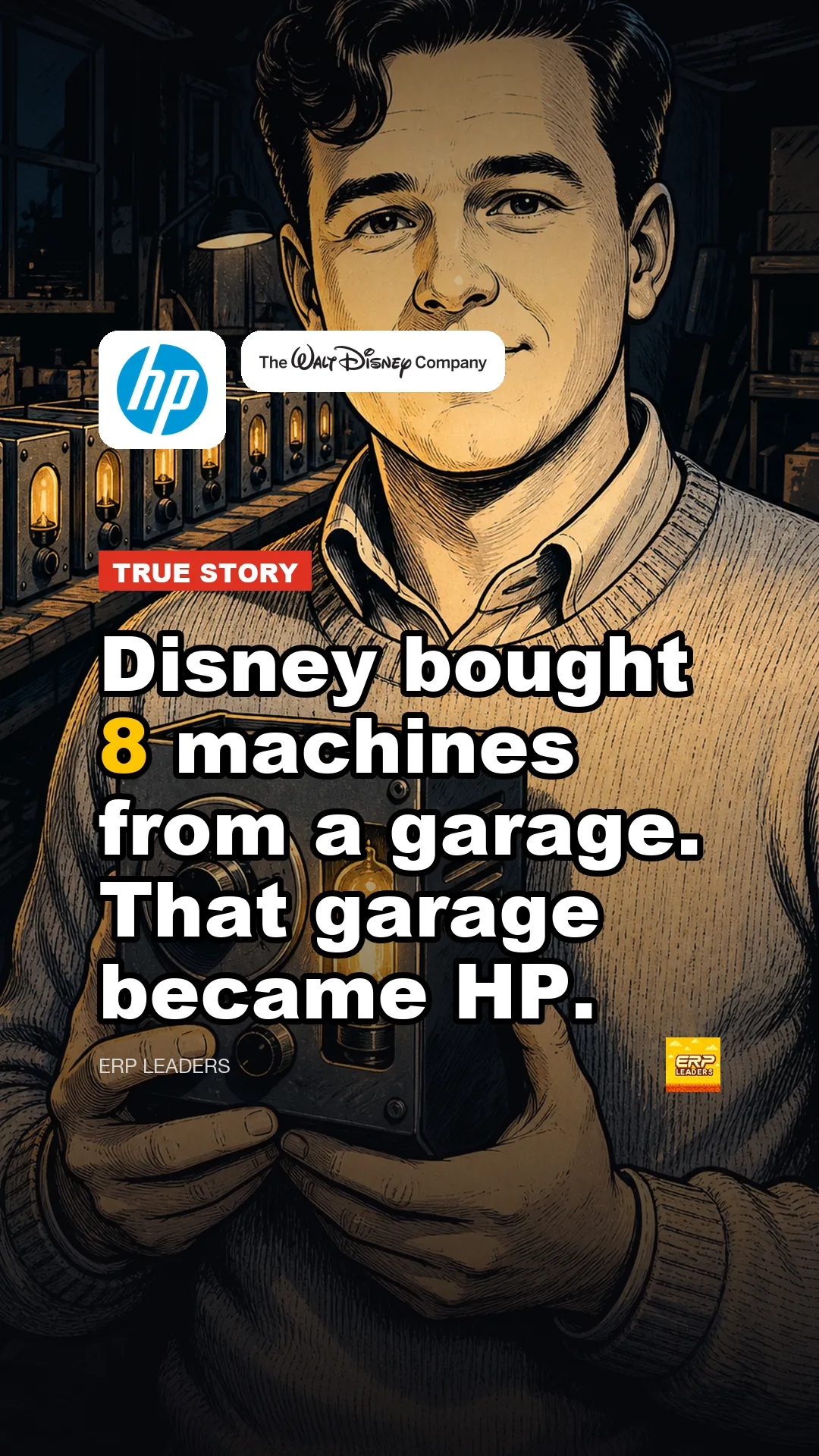
Disney bought 8 machines from a garage. That garage became HP.
In the fall of 1938, Bill Hewlett and Dave Packard set up in a 12-by-18-foot garage in Palo Alto with $538. Their Stanford professor, Fred Terman, found research money that paid Packard $55 a month, so he could take leave from General Electric. He never went back.
Their first product was an audio oscillator, a box that makes test tones for sound equipment. Hewlett kept its output steady with a light bulb. It sold for $54.40, a price that made no profit, while rivals charged $200 to $600.
In November 1938 they showed the prototype at a radio engineers' show in Portland. Disney's chief sound engineer saw it there and liked the price. He later asked for a special version for the new theater sound system of Fantasia. Walt Disney Studios bought eight. HP's own history calls it "the company's first big sale."
Early sales paid for better models, and in 1940 HP left the garage. In 1989 California named it "the birthplace of Silicon Valley." For fiscal 2025, HP Inc. reported $55.3 billion in revenue.
For enterprise software sellers, the telling detail: the first product made no profit, and the first big sale was a version built to one customer's request.
AI-generated illustration with narration by an AI voice.
HP
What the captions say
- This is the story of how two engineers with $538 started HP in a garage, now called "the birthplace of Silicon Valley."
- It was the late 1930s, deep in the Great Depression, and they had almost no money.
- Their Stanford professor, Fred Terman, found Dave Packard $55 a month in research money. So Packard stepped away from a steady job at General Electric.
- He never went back. That fall, he, his wife and Bill Hewlett moved to Palo Alto, and the two men set up in a garage.
- Hewlett had put a light bulb inside an audio oscillator, a box that makes test tones. The bulb kept the output steady, without distortion.
- They numbered it 200, so it wouldn't look like their first. Rivals charged up to $600. Theirs sold for $54.40, at no profit.
- In November 1938, they showed it at an engineers' show in Portland. Disney's chief sound engineer saw it, and liked the price.
- On New Year's Day 1939, they formed their partnership. A coin toss decided whose name came first.
- Disney's sound engineer asked for a special version, for a film with a new theater sound system: Fantasia.
- Walt Disney Studios bought 8 of the special oscillators. HP's own history calls it "the company's first big sale."
- Early sales paid for better models, and in 1940, HP left the garage.
- For 2025, HP Inc. reported $55.3 billion in revenue. And it all began with a light bulb in a box.