

Alan Turing helped crack Enigma. In 1952 Britain put him on trial.
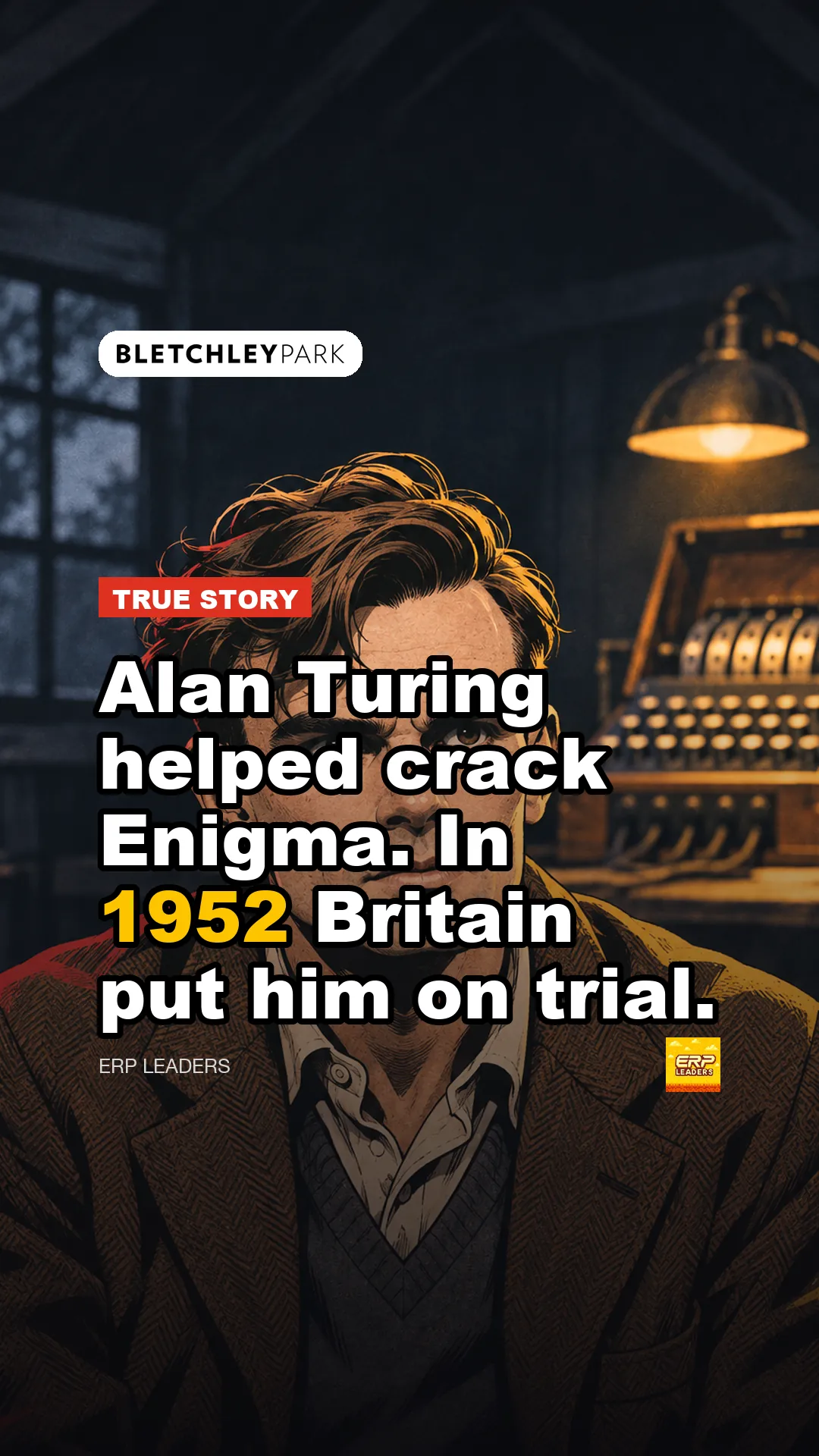
In 1936, at 24, Turing described one machine that could do any well-defined task, given a program. Today we call it a computer.
At Bletchley Park he turned a Polish device into the Bombe, and by mid-1941 his team was reading U-boat messages. Then staff shortages began to delay the work. On 21 October 1941 Turing and three colleagues wrote to Winston Churchill that the German navy's code keys were "being delayed at least twelve hours every day." Churchill's note the next day: "Make sure they have all they want on extreme priority."
In March 1952 Turing went on trial over a relationship with a man. Rather than prison, he accepted a year of hormone injections and lost his security clearance. He died in June 1954, aged 41. In 2009 Gordon Brown apologised. In 2013 the Queen pardoned him. Since 2021 his face has been on the Bank of England's £50 note.
For anyone running IT: Bletchley had enough Bombes in 1941. It was short of about 40 clerks and typists, and that delayed the navy's code keys by at least 12 hours a day.
AI-generated illustration with narration by an AI voice.
Which of your projects has the machines but not the people?
What the captions say
- This is the story of how Alan Turing helped crack Hitler's Enigma, and how Britain put him on trial in 1952.
- In 1936, Turing was a 24-year-old Cambridge mathematician. He described one machine that could do any well-defined task, given a program.
- No such computer existed yet. When war came in 1939, he joined the codebreakers at Bletchley Park.
- Their enemy was Enigma, the German cipher machine. The navy's version was thought unbreakable.
- Turing turned a Polish device into a far more powerful machine, the Bombe. By mid-1941 his team was reading U-boat messages.
- By October they had too few hands. The navy's keys were found at least 12 hours late, every day.
- So Turing and three colleagues wrote to Prime Minister Winston Churchill, on their own initiative.
- They asked for about 20 clerks and 20 typists. The next day Churchill wrote: "Make sure they have all they want on extreme priority."
- By November staff were arriving fast. After the war, he designed one of the first electronic computers, his 1936 idea made real.
- In March 1952, Turing went on trial over a relationship with a man. He made no serious denial. The charge was gross indecency.
- Rather than go to prison, he accepted a year of hormone injections. His security clearance was withdrawn. He died in June 1954, aged 41.
- In 2009 Prime Minister Gordon Brown said: "We're sorry, you deserved so much better." In 2013 the Queen pardoned him.
- Since 2021 his face is on Britain's £50 note, beside his own words: "This is only a foretaste of what is to come."