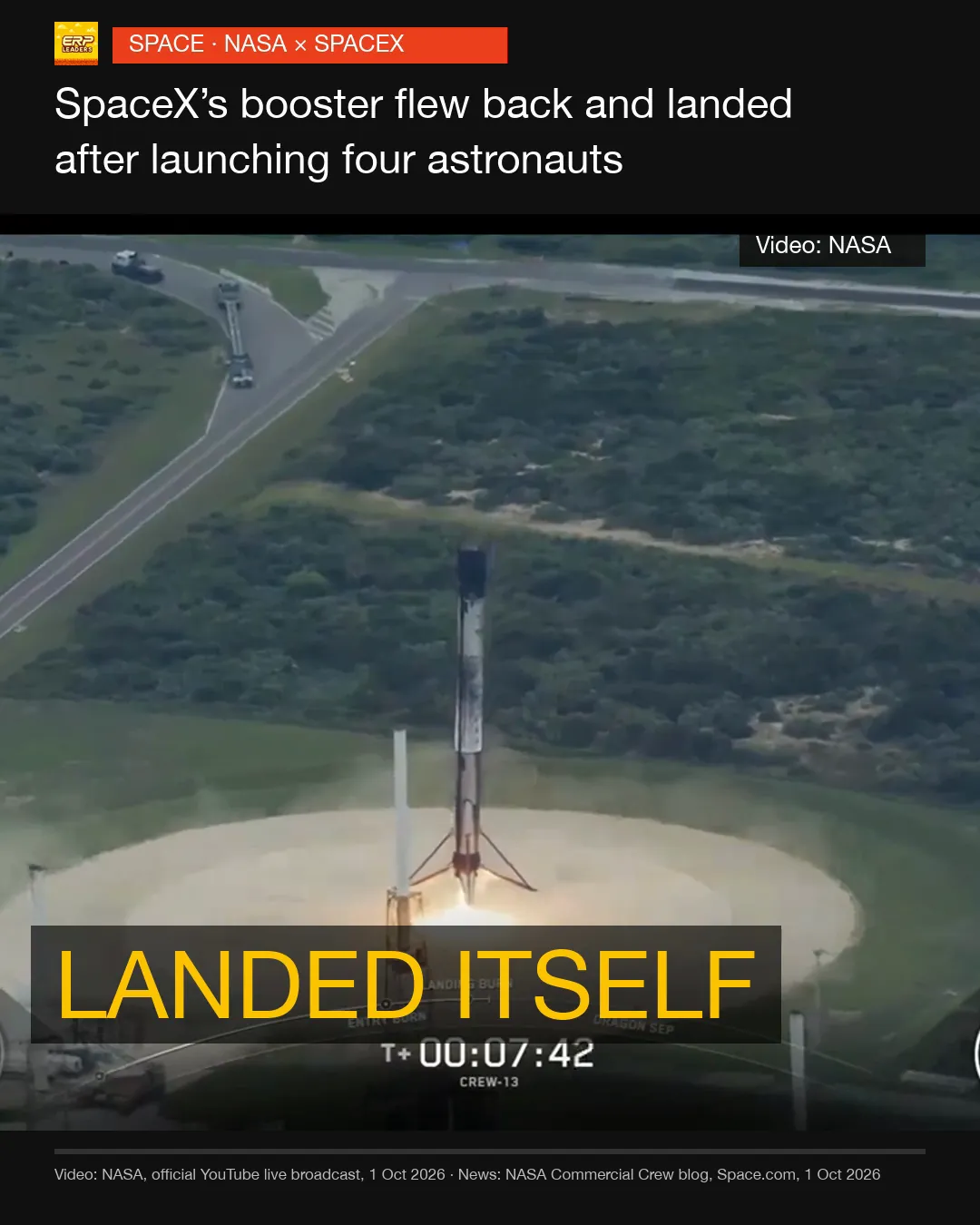
SpaceX launched four astronauts, then its booster flew back and landed upright.
NASA buys the trip to the International Space Station from SpaceX as a service rather than owning the rocket. Crew-13 is the 13th crew rotation flown under that contract model.
The Falcon 9 lifted off from Cape Canaveral, Florida, at 11:10 a.m. Eastern on 1 October, carrying the Dragon capsule Grace. On board were NASA astronauts Jessica Watkins and Luke Delaney, Canadian Space Agency astronaut Joshua Kutryk and Roscosmos cosmonaut Sergey Teteryatnikov.
After the stages separated, the first stage (the large lower part of the rocket) fired its engines and turned back toward Florida, NASA said. NASA's broadcast clock read 7 minutes 41 seconds when it touched down at Landing Zone 40, next to the launch pad. The second stage carried the crew on to orbit.
SpaceX recovers that stage so the same hardware can fly again. NASA buys the transport as a service, but it sets the requirements and certified the spacecraft for its crews. SpaceX owns and operates the vehicle.
Which service in your own company could you specify that tightly before you stop owning the hardware behind it?
🎥 Video: NASA, official YouTube channel (launch broadcast) · narration: AI voice
What the captions say
- The booster flew back and landed upright.
- Liftoff 11:10 a.m. Eastern, 1 October.
- Four astronauts aboard the Dragon capsule Grace.
- The stages split. The booster turns back.
- Grid fins steer it down through the air.
- Touchdown at Landing Zone 40, T+7:41.
- The second stage carries the crew to orbit.
- Footage: NASA's launch broadcast.