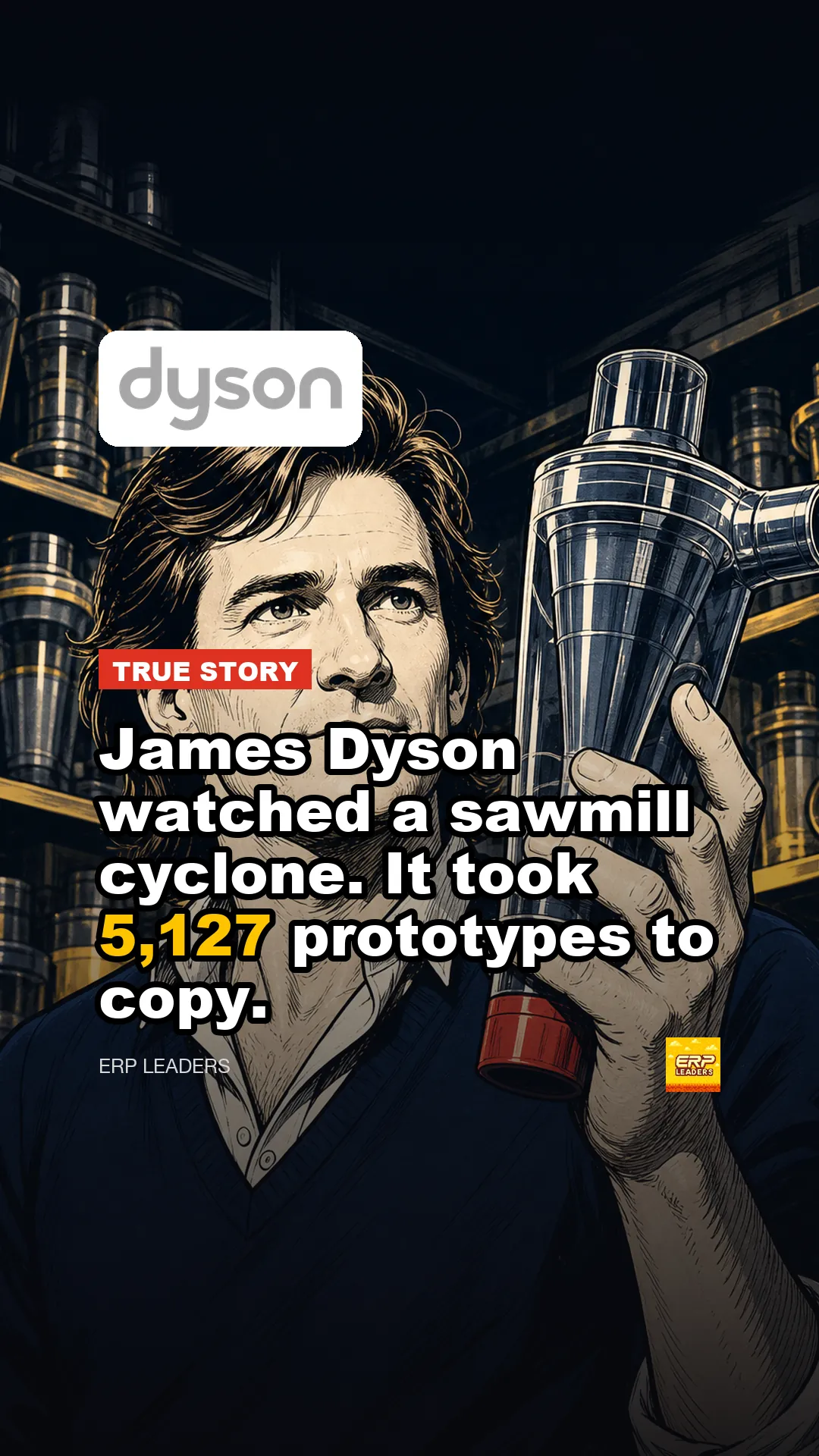
James Dyson watched a sawmill cyclone. It took 5,127 prototypes to copy.
He spent five years in a garden shed while the family ran short of money.
In 1978 Dyson's new Hoover Junior kept losing suction because its bag clogged with dust. He saw a sawmill using a cyclone to pull sawdust out of the air, then removed the bag from his Hoover and taped on a cardboard cyclone. It worked. He built the prototypes in the shed behind his house. "By 2,627, my wife and I were really counting our pennies," he later wrote.
The big vacuum makers would not take the design; a bagless cleaner would have disturbed their market for replacement bags. A Japanese company, Apex, licensed the design, and a bright pink version went on sale in Japan in 1986 for about $2,000. With the licence income he set up his own company, Dyson, in 1991. His own factory finished its first vacuum, the DC01, on 1 July 1993. Within 18 months, that model was the best-selling vacuum cleaner in Britain. Forbes puts his net worth at $14.8 billion this month.
One-minute true story. AI-generated illustration with narration by an AI voice.
Have you ever seen a good idea turned down because it threatened something that already made money?
What the captions say
- This is the story of how James Dyson became a billionaire. His vacuum came from a sawmill, and took 5,127 prototypes.
- In 1978, James Dyson was a designer in England, with a new Hoover Junior.
- The Hoover lost suction as its bag clogged with dust. Then, near his home, he saw a sawmill that used a cyclone to spin the sawdust out of the air.
- He went there at night and took measurements. At home he pulled the bag out of his Hoover and taped on a cardboard cyclone. It worked.
- Then Dyson went to the shed behind his house and built prototypes, one after another, for five years.
- In his words, by the 15th prototype his third child was born. By number 3,727, his wife was giving art lessons for extra cash.
- The big vacuum makers would not take it. A bagless cleaner would hurt their business in replacement bags.
- Then a company said yes. It was in Japan. A firm called Apex licensed his design, and from 1986 a bright pink version sold for about $2,000.
- With that money he set up his company. On 1 July 1993, his factory finished its first vacuum, the DC01.
- Within 18 months, it was the best-selling vacuum in Britain. A court ruled that Hoover had copied his patent. Hoover agreed to pay £4 million.
- Forbes now puts his fortune at $14.8 billion. Dyson wrote, "Each failure brought me closer to solving the problem."