Google fired protons at AI chips to mimic five years in orbit.
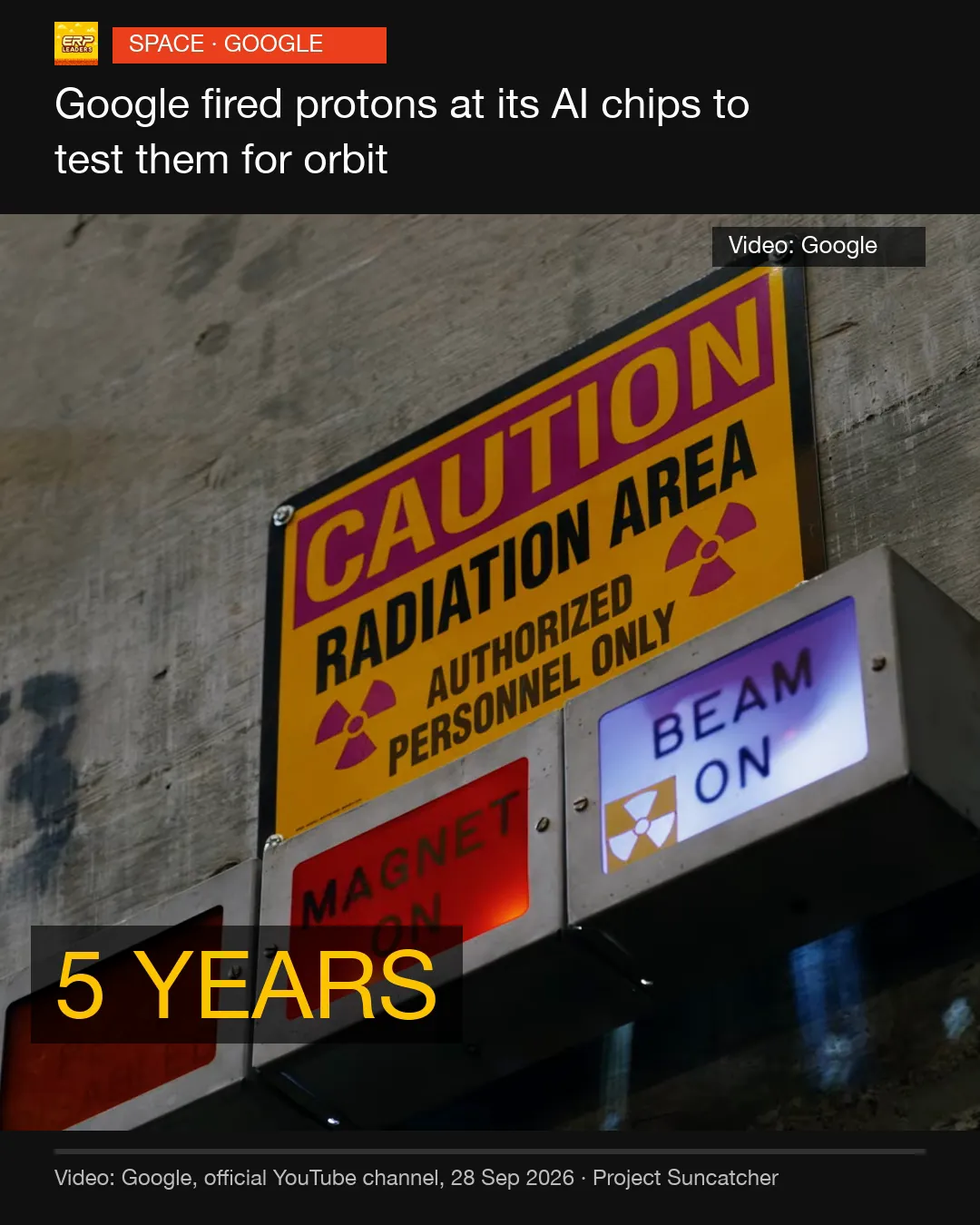
Google wants solar-powered AI data centres in orbit. Its Project Suncatcher team showed today how it tests its TPU chips for the launch and five years in orbit.
The ride to low Earth orbit takes about 10 minutes, with sustained loads of up to 10 times gravity, Google says. The chips themselves can see 50 to 100 g. Its partner Planet designed the packaging, and Google shook a prototype on a vibration table in all three axes.
Then the chips went into a proton beam, running real AI workloads, to test five years of radiation in the planned orbit. Google says the TPUs "held up remarkably well". The same test also produced what Google calls a "silent data corruption" (SDC): a wrong result with no error raised. It was Google's first in a beam test.
Google calls ordinary bit flips correctable. An SDC raises no alarm, so it can flow into a model's training unless a later check catches it. The film gives no rate.
Google's argument is that commercial chips could go to space without the long design cycles needed to make them space-rated.
How would your team catch a result that is wrong but looks fine?
🎥 Video: Google, official YouTube channel · narration: AI voice
What the captions say
- Google fired protons at its own AI chips.
- The beam mimics five years in orbit.
- Google wants AI data centres in space.
- A launch pulls up to 10 times gravity.
- Partner Planet shook the chip package on a table.
- Under the beam, the chips ran real AI work.
- One fault corrupted data without any alarm.
- Google says the chips held up remarkably well.